Rons Primitive Skills

Custom Search

Search This Blog

Showing posts with label wood working. Show all posts

Saturday, January 7, 2023

My all time favorite primitive technology books

 I have a sizeable library. Physical books- probably around 500. Digital books and other type documents- probably around 100,000.  I have been interested in nature since I was old enough to walk. So, a vast majority of my books are on nature subjects-  rocks, plants, animals, etc. I have a lot of survival books. I have a lot of gardening and self reliance books. My favorite though, are my primitive technology books. My collection of physical PT books are:

Primitive Technology vol 1 & 2 edited by Wescott

Practicing Primitive by Watts

all 3 Woodsmoke books by the Jameson's

Both volumes of Primitive Wilderness Living by the McPherson's

Survival Arts of the Primitive Paiutes by Wheat

Wilderness Survival Handbook by Pewtherer

Can you Survive by Pressley

And the one that started it all......Outdoor Survival Skills by Olsen

In 1976 I picked up a copy of Olsen's book at the ARMY PX bookstore when I was stationed in West Berlin, Germany. I thought  "this is it!  When will there be more work on this subject?" It had just come out in paperback. By the way I still have this book. All I did was put a clear plastic jacket on it. It looks to be in pretty good shape for all the field work it saw. I made a carry case out of hard, thick rawhide to protect it on my ventures. West Berlin was around 100 miles behind the "Iron Curtain" in East Germany, the Communist German Democratic Republic, a Soviet ally at the time. What a lot of folks don't know is there are large areas of forested land in Berlin. The one I roamed was the Grunewald which translates to "green forest". There were some pretty secluded areas and the only threat was the huge European wild pigs. Those things looked like small rhinos when you saw them running through the woods! And they could be downright mean! There were red deer too. And of course rabbits and squirrels. Fires were a no-no but if you were smart and built a small smokeless fire all was good. I had many a good time on my days off out in the 'wald.

Notice that some of these books have "survival" in the title. I would say that they are more geared towards primitive skills than modern. The book by Pewtherer covers some modern necessities such as first aid kits (I always carry a small modern geared kit when I go woods running) and some other modern tools like a compass and survival kit. The rest is surviving from a primitive technology view point. Ben Pressleys book is almost all primitive except he shows how to use a fire steel and there are a few photos of him in a 18th century long hunters outfit. This is all just fine with me. I live in both worlds but I prefer primitive tech and skills. Its more a hobby thing. I use modern tools like saws, axe's, steel knives and such for my primitive projects if it requires serious stock removal. I've done many purist stone, bone  antler & wood bow building and other projects but my joints are showing the damage done to them over many years of this type work let alone all the years doing most of my building construction by hand. It gets to ya quick so if there's an easier way I'll go that route. There are days when I can hardly bend my fingers and my wrists pulse with pain but I keep plugging along. Life is too much fun to give in to pain and discomfort. I just cut a little slower now.

I'm always looking for more stuff to write about and if there is something you would like me to research please let me know. I'm in need of resources such as bone, antler, hides and rock so if you have any extra I would be pleased. I have a few things to trade. Until next time, take care and enjoy life. Make as much of it as you can!

Tuesday, December 10, 2013

Green Carving Wood-Yaupon

Back in the middle of November I was clearing some of the brush and small trees from around the property. I took down the largest yaupon holly tree, Ilex vomitoria, I have yet seen. It was 20 feet tall and had a diameter at the base of 5 inches. I decided to cut it into 2 foot sections and seal the ends with latex paint for future carving material.  The reason for sealing it is the habit of all holly trees to check and crack like crazy if they dry too fast. Its such a dense and beautiful wood and I don't want to waste an inch.
Yaupon isn't scarce here. I can count 100 of his cousins in 10 minutes within 20 feet of the stump. I have a few other holly trees in line for harvesting and I believe they are American holly, Ilex opaca. None of them are as large as the yaupon tree I took down, most being at the most 3 inches in diameter. These, too, will get the same treatment as the yaupon. I let the yaupon log air out and dry a little in the shade for about a month before I cut it and sealed it. I then moved the wood to our aviary to keep it out of the weather and give it a cool, shady place to dry. This wood is used for turning, inlay and carving. I plan to make a lot of spoons and utensils with some of this wood. A search for green wood carving has show quite a few pages and a lot of info on the subject. Looks promising. Here's a link that mentions yaupon holly in a wood working forum. Its the last post at the bottom: http://lumberjocks.com/topics/8709

Here are some photo's.


2 foot sections fresh cut & ready to treat

3 1/4" should be plenty big enough to get some good carvings. This wood will yield a lot of spoons and kitchen utensils as well as other good things!
Nice clean wood with a lot of potential.
I weighed each one to see how much they will loose after a month or so. It will probably take a few years to completely season and dry. I intend to sell them green as well as seasoned.
Another nice log.


Even the small stuff has some potential.
Sealed and ready to be put up.

In the aviary drying and waiting for sales.


Thursday, December 5, 2013

Florida-Busy Making Preps and Life in General

Well, I made it through the hot and humid Florida summer. This has been a typical subtropical winter with highs being in the hi 70's today. Water is NOT a problem here! There is so much of it coming down. We had one day where there was a rainfall of 4 inches in a little over 10 hours. With the right storage system a person could store a lot of water for the garden. Speaking of gardens, we have our winter crops in and new seeds are under the lights right this minute. I have been checking out the local fauna & flora. The variety of insects is incredible, especially the spiders. Of course there is the Florida state bird, the mosquito. I hate those things with a passion but I have seen a few of the local "insect repellent" plants such as dog fennel and beauty berry. I tried beauty berry leaves this summer and by darn, it works! As a plus the berries are edible and can be used for making jelly and have medicinal properties. We, my fiance Annie & I, are selling some local natural items in our eBay store as well as the usual stuff. Look on my eBay link at the top right column to see what we have if you're interested. This economy is getting very rough and we are barely making it but we work hard and by the Good Lords blessings we do OK. I am doing research and some things with yaupon holly, Ilex vomitoria. The famous "black drink" was made by the local Native Americans from it, and I plan on seeing if selling the leaves for tea is feasible. The yaupon has a caffeine content that is less than coffee or tea, but enough to satisfy any craving for caffeine. "Dry, unprocessed yaupon leaves contain between .65 percent and .85 percent caffeine by weight. Coffee beans are about 1.1 percent caffeine by weight and tea leaves about 3.5 percent caffeine," according to a University of Florida article. As a plus they are rich in certain vitamins and antioxidants. I can reach out the bedroom window and grab a handful of yaupon leaves, its that abundant down here. Kind of like sage brush out in good ole' Idaho. Worth a web search if you are interested. It was used in the 1800's and during the Civil War as a coffee and tea substitute and unlike some other substitutes, it stayed around for a while until coffee became more plentiful and cheaper. I've read where birds will eat the berries but only as a last ditch effort in late winter. They must be considered as a "starvation food" among our feathered friends. Also, the wood is very nice and has been used for turnings, inlay and carvings. I removed the biggest yaupon I have ever seen from our goose pen. It was 20+ feet tall and about 6 or more inches in diameter. I am cutting it into 3 foot sections and sealing the ends. We have an aviary that's not in use so I'll stash it in there till its dry enough to use and sell. I don't know how well it does as a green wood for carving and I've read that the holly's have a nasty habit of cracking and checking if it drys too fast. Here are some shots of the local yaupon bush's. I'll be posting more interesting stuff in the near future as time permits. Thanks everyone and enjoy the holidays!


Saturday, December 17, 2011

Side hafted microblade

After seeing these on Elfshots blog http://elfshotgallery.blogspot.com/2010/02/palaeoeskimo-side-hafted-microblades.html I decided I had to make one. It was surprisingly easy, kind of like a Hoko knife. With modern tools (my Warren carving knife with a straight blade and a tiny gouge) it went quick, less than an hour. With stone tools and depending on experience it probably took the old ones maybe an hour or less. I used artificial sinew split up into many strands and no glue. The original article doesnt state if glue was found on the preserved artifacts and I really don't think hide glue was all that common on the Arctic and sub Arctic coastal areas. Tim Rast, the owner of Eflshot is a professional archaeologist and maker of things ancient. He has made a bunch of these out of wood, antler, and bone. Please take the time to peruse his site for the many excellent articles on Eskimo and related cultures and their artifacts.

This shows the groove where the blade sets.


Here's a shot of the handle with two notches for the cordage. I used cottonwood for this knife.
This shot shows the brace which is held snug against the blade when tied in place at the two notches on top..
This shows the notch in the brace which sets against the blade.
Here's the blade. I made it from a piece of flint I found in Colorado.
This shows everything set up ready to finish.
This is the completed knife. Overall length is 5 inches.
Closeup of the finished knife. Stone, wood, sinew-a simple but efficient tool.

Tuesday, November 15, 2011

A few more block planes

I got a nice comment from DeanO, it can be read in the comment section at the bottom of the post, about collecting and using old planes. I have several that are considered collectibles and the difference is I bought them for use instead of shelf decorations. Why buy and use old tools? Because they were made very well and most of them are still in top working condition. Plus, the tools you buy today are either junk or very, very expensive. If you shop around you can pick good old tools up fairly cheap. All of my planes combined cost less than $50. total. You can pay a lot more, but careful shopping and patience will reward you.

I use these little planes for making tool handles, bows, arrows, atl atl's, and many other primitive/bushcraft kind of things. Its easy to keep the blades sharp and with patience and practice a person can adjust them to take off paper thin shavings.


This one is a "bull" or "rabbet" plane. It's about 3 1/2" long and has a 1" blade. This one is designed for sash and cabinet making. Its for cutting rabbets and to plane into blind corners. This one is similar to a Stanley #75. Its marked "H. BOKER & CO. GERMANY" in a circle on the iron

This is a cast iron block plane. Its 3 1/2' long and has a 1" blade. These come in a variety of styles and are common. This is a Stanley #101.

This is a combination wood and iron adjustable plane. Its called a "transitional". Its the biggest plane I own and measures 7 1/4" and has a 2" blade. This is for removing a lot of wood at once. I can turn out a good rabbit stick in half an hour with this plane. Manufacturer unknown.

Friday, November 11, 2011

Refurbishing a vintage wood working plane

I own and use a variety of small planes in my carving and primitive woodworking projects. Nothing makes for a nice smooth ax or adze handle than a sharp plane. I use them for a lot of different jobs. I recently bought an X-Acto #29 plane on eBay for a couple bucks. It was in good shape when I received it but there was some surface rust and the blade was badly nicked. Obviously it sat in a dusty corner for many years. These were made in the 1940's up until the 90's. The latest X-Acto plane doesn't look at all like these. I don't know if they switched to plastic in later years, but the old ones like this were made from Bakelite, one of the first plastic materials. These planes came in some of the better kits and in later years I believe they were sold separately.

First off was to take the plane apart and put some 320 grit carbide paper to the sole and get rid of the rust. Fortunately, it is just a mild case of surface rust from setting around neglected for many years. Next I used some lite machine oil on a rag and wiped the surface of the plane body. This brought it back to a nice shine. Other than the Bakelite body, the sole and iron are made of steel. The cap is some kind of nonmagnetic alloy like pot metal and the adjusting screw is brass. I threw the iron away because I managed to pick up a killer deal on about 20 brand new ones quite a while back. They're still in the original wrappers and marked X-Acto #29 Made in U.S.A. That's part of the reason I wanted a #29 plane.

As it came in the mail. 3 3/4" long and the iron or blade is 15/16" wide. Body is 1 1/2" wide.

All the parts. The iron is a new one.

The sole after a good sanding. I haven't done the ends yet.

A nice shiny polish on the sole.
End view.


Mostly finished and put back together.

The more common cast iron mini block plane. These were made by Record, Stanley, and many others and are easy to find. They come in a lot of different shapes and styles. This one has only the marking "BL". 3 5/8" long by 1 1/4" wide. Iron is 1" wide. This one was made by Great Neck Tools.

Oh, and happy Veterans Day everyone!

Friday, November 4, 2011

Wood carving goodies in the mail!

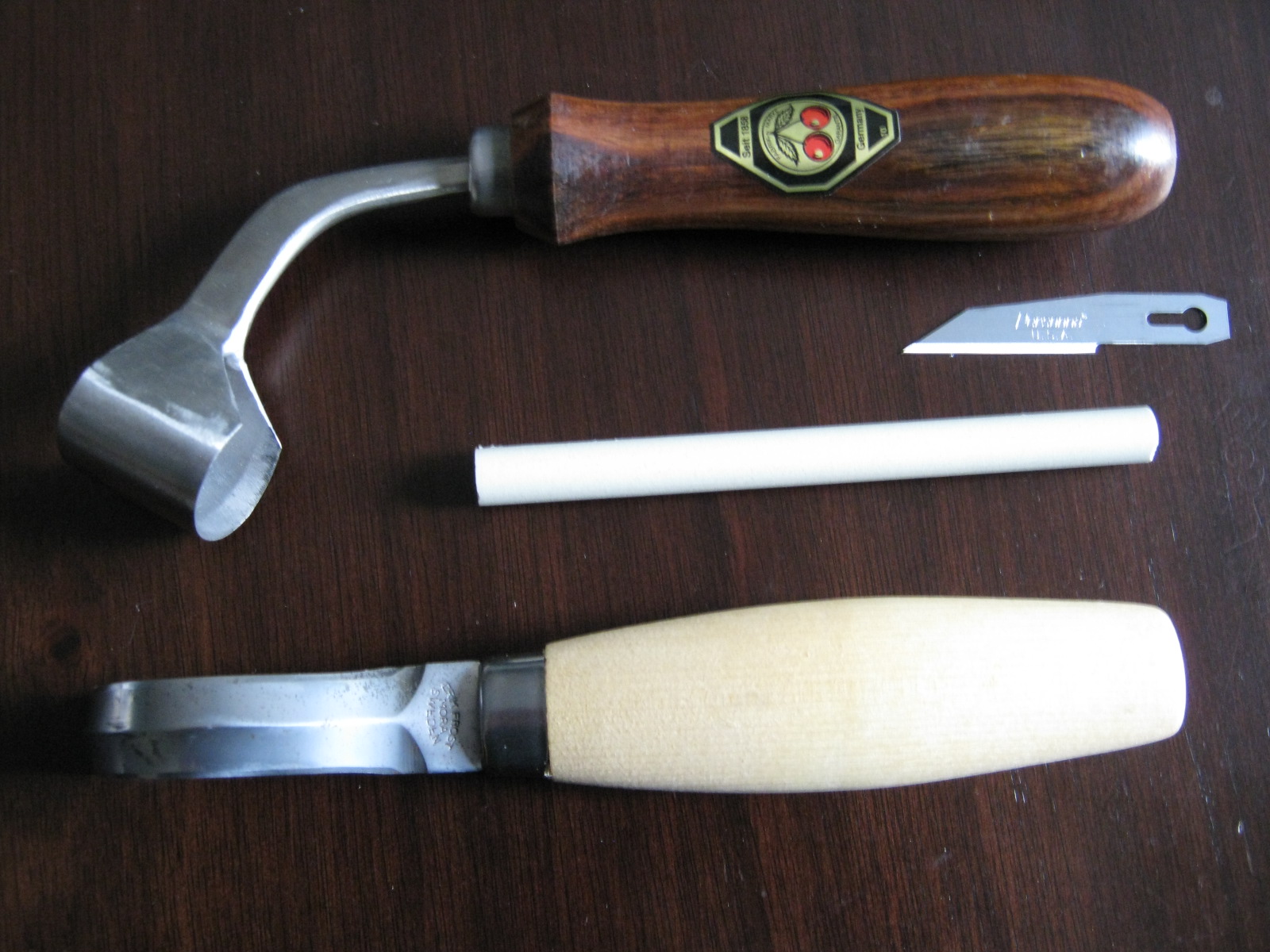
I just went to the mail box and gathered my new toys! I bought a Two Cherries carvers scorp, another Mora half curve knife from Bens Backwoods and a whole lot of X-acto type blades on eBay. Oh, and a nice little ceramic sharpening rod for my carving tool box. The Two Cherries scorp is 7 1/2" long and the opening is right at 1" across. I managed to find one on sale for $40. They usually run around $50 to $60. This one came from http://www.craftsmanstudio.com/html_pc/L5152275.htm Its top quality German made and very sharp! The Personna blades were in a quantity package deal. I think I'll make up a nice carving knife kit in the future using these blades. They fit the X-acto #2 and #6 handle just fine. The Mora #163 is one I've been wanting to get for quite a while but more important things kept popping up. Heres a link to better describe the #163: http://www.bensbackwoods.com/servlet/Detail?no=92
I bought the ceramic rod from Bens for all of $1.98. Looks like I'll be making a lot more shavings this winter.

Top to bottom: Two Cherries scorp, Personna USA blade, ceramic rod, and Mora #163

Wednesday, August 10, 2011

A good ax

An ax can be a God send or a death sentence-or at the very least a trip to the emergency room! I have seen some very nasty wounds from ax misuse. A glancing ax is an ax out of control. Period. And when it stops in your leg, its going to cause an awful lot of damage and bleeding. This is why a lot of folks consider it too dangerous to carry. Some depend on big blades like Kukri's, machete's and others. Well, if you don't have enough practice with these tools or are careless, you will still suffer in the end. I was fortunate to have started with a hand ax at an early age. It was an old one with a hammer poll and a cutting edge of about 4 inches. It was my grand father's and I had to put it back clean after every use. Pap was good at keeping it sharp and showed me how to cut with it and how not to take a leg off. I paid close attention to him and never suffered any self inflicted wounds. I cut many a sapling and downed trees for fire wood and other things I would make in the woods. I was told to never bury the blade in the dirt and to sink it into a log or stump of dead, dry, wood. This kept the sharp edge covered and dry won't make it rust. I would always (and still do) place my feet apart and well back from the area where I was going to take a swing. Not enough to loose balance but to avoid the ax edge if it glanced. I was taught to think each swing ahead and thus avoid glancing blows.
I've had a few different axes over the years and one of the best has been my little Norlund. It is considered a small camp ax and has a head 5 1/8" long and a cutting edge 3 1/8" wide. The head is 7/8" at the thickest point. I bought mine for around 50 cents and it was without a handle. The handle I put in is 14" long. I like it that way. It gives a little more power to the swing. There's no reason to fear such a handy woods tool. Our ancestors used them every day. It just requires a good dose of common sense and paying close attention to what you are doing. Never attempt to interrupt or have a conversation with a person who is chopping. It can lead to some nasty accidents.


Monday, October 12, 2009

Update 2 on staff

The staff is completely dried and by leaving the bark alone there are no cracks. I removed the thick layers of glue from the ends and everything is bone dry. I had it on my balcony and it was low humidity and over 100 degrees for a month so I'm sure that had plenty to do with it.

Saturday, September 12, 2009

Update on walking stick or staff

The staff project is going very well. I had to apply wood glue to the ends every day for nearly a week to seal any new cracks. For the past two days it has held up well and there are no new cracks showing. The glue and the fact that I left the bark on has done a great job of keeping it intact. I have included a photo that shows a mulberry rabbit stick that I got about the same time. I de-barked it and let it dry out. You can see the horrendous cracks that developed. These are all along the length of the stick. Its still a good "down and dirty" type of quick build stick but it shows what happens when you hurry things. Patience is a virtue. Had this been a bow stave it would be ruined.


Tuesday, September 8, 2009

The staff

I subscribe to Backwoodsman Magazine and have for many, many years. Its the best outdoors magazine there is in my opinion. This latest issue had an article about the versatile staff. One thing I read makes a lot of sense and that is if the staff is taller than you are there is a lot less chance of trying to impale yourself in a fall. Good idea! So, anyway, I managed to rescue this from the tree shredder about two weeks ago and its a mulberry sapling about 6'8" long and 2" diameter. I'm 6'2" so this is fine. I've been coating the ends with wood glue to keep it from cracking and I plan to leave the bark on. It seems to want to crack a lot so I give it a good coating every day. I imagine I'll be doing this till it stops since its green and wet. I'll be sure to post any further modifications in future posts.


Wednesday, August 12, 2009

Rabbit sticks

This is an article about rabbit sticks. Some folks call them throwing sticks which can cause a bit of confusion because atl atl's and throwing boards, related to dart throwing, are also called throwing sticks. The rabbit stick was used over a large part of North America since prehistoric times. It was most popular in the west and southwest. This is due to the open areas and the ease of seeing game at a distance. I have seen some rabbit sticks which were no more than a straight piece of limb with no wood removal including the bark. These must be the most rudimentary form of rabbit stick. Most tribes used a refined stick that was carved to an aerodynamic shape like an airplane wing in cross section. This made the stick glide over the ground for a long distance and the skilled thrower could take out a rabbit at quite a distance. Some sticks were not worked to the point of being aerodynamic but they were more heavy and may have been used for larger game like small deer. I have seen some that were almost round in cross section and fairly heavy.

The picture below shows the normal throwing stance for throwing the rabbit stick. Its kind of like throwing a flat stone to skip over the water. Some throwers use the "across the chest" throw which is holding the stick in your right hand with the stick slightly over your left shoulder. Kind of like a frisbee toss.


The next picture shows a stick I made from cedar. Its somewhat oval in cross section. It's 24 1/2" long, 2" wide and weighs around 8 ounces. The stick below it is made of sycamore and weighs around 5 ounces. Its 21 1/2" long 1 3/4" wide and is aerodynamic in cross section.


The next seven pictures show the process of working the limb into a rabbit stick. The first photo shows the beginning of the wood removal. I use a small hand plane (shown in fourth photo) to take of shavings on each side until I get an idea of how the shape will come out.


These next two photos show the stick with both sides equal in flatness and ready to start final shaping.

This photo shows the still unfinished stick and the tools I use: a small hand plane and my Gerber Freeman. Not shown is a "four-in-hand" file I use for final smoothing.


This next photo shows the cross section.


This photo shows the handle which is simply a few notches for a good grip.


Here's the finished stick. It shows how much wood is removed in the shaping process. I save the shavings for making fire starters and I always carry a big bag full for ready made tinder.


This next photo shows the piece of incense cedar I used to make the big rabbit stick.


Here's a shot of the end of the stick showing the cross section. This stick is not made to be aerodynamic but to be a heavy killing stick. It's for close range hunting.

Here's a shot of the handle. Like the sycamore stick, I only used the small hand plane, Gerber Freeman and "four-in-hand" to make this one.

This shot shows how thick the stick is.

Here's a shot of the finished stick.


If you care to learn more you should check out Paul Campbells book "Survival Skills of Native California". It has an excellent section on the construction and use of rabbit sticks. I fashioned the cedar stick after one made by the Mojave Indians of the Arizona/California border area.

Friday, January 30, 2009

Wood carving

Here are some photo's of an Owl I carved about 2 years ago. Wood carving helps improve manual dexterity and was actually taught as "manual training" in schools during the 1800's through early 1900's. Do a search at Internet Archives http://www.archive.org/details/texts for "Sloyd" or "Slojd" and you'll see. Notice the style of knife used. Its a Scandi very similar to a wood handled Mora. Matter of fact it probably is a Mora. Basically, the more you practice carving the better and faster you become. In a survival/bushcraft perspective, knocking out a spoon, tent peg or trap part in a few minutes is a valuable skill.

These knife illustrations are from a few of the books available for free download from the archive.
Here are a few titles;
Barter-Woodwork (the English Sloyd)
Hoffman-The Sloyd System of Wood Working
Larson-Elementary Sloyd & Whittling
Salomon-The Teachers Hand Book of Slojd
Schwartz-Sloyd
Sutcliffe-Hand Craft


The owl is carved from a growth that forms on mesquite trees when they are attacked by mistletoe. They look kind of like a club and usually stand straight up on the limb. Unfortunately a lot of mesquite trees are dying from the excess mistletoe growth. I read somewhere that the Indians harvested the mistletoe from the trees. Since this is no longer done the trees are in danger.