Today my freind and I went to Celebration Park near Melba, Idaho. Its on the Snake river in the canyon lands. Its Idahos first and only archaeological park and the trip was well worth it. First stop was the visitors center. Here you can see some nice artifacts as well as very well done reproductions.
Here are a few shots of some things in the cases. Most of the artifacts were found in the park including the water basket.
 |
| These ax's and woodworking tools are replicated by an archaeologist. Great job! |
 |
| There are some nice points and blades in this display. I spotted a very nice drill. |
 |
| This shows some very rare pottery fragments and the drill is in the second row down to the far right. These Indians rarely used any pottery because of their nomadic lifestyle. They traveled for hundreds of miles and they traveled light. |
 |
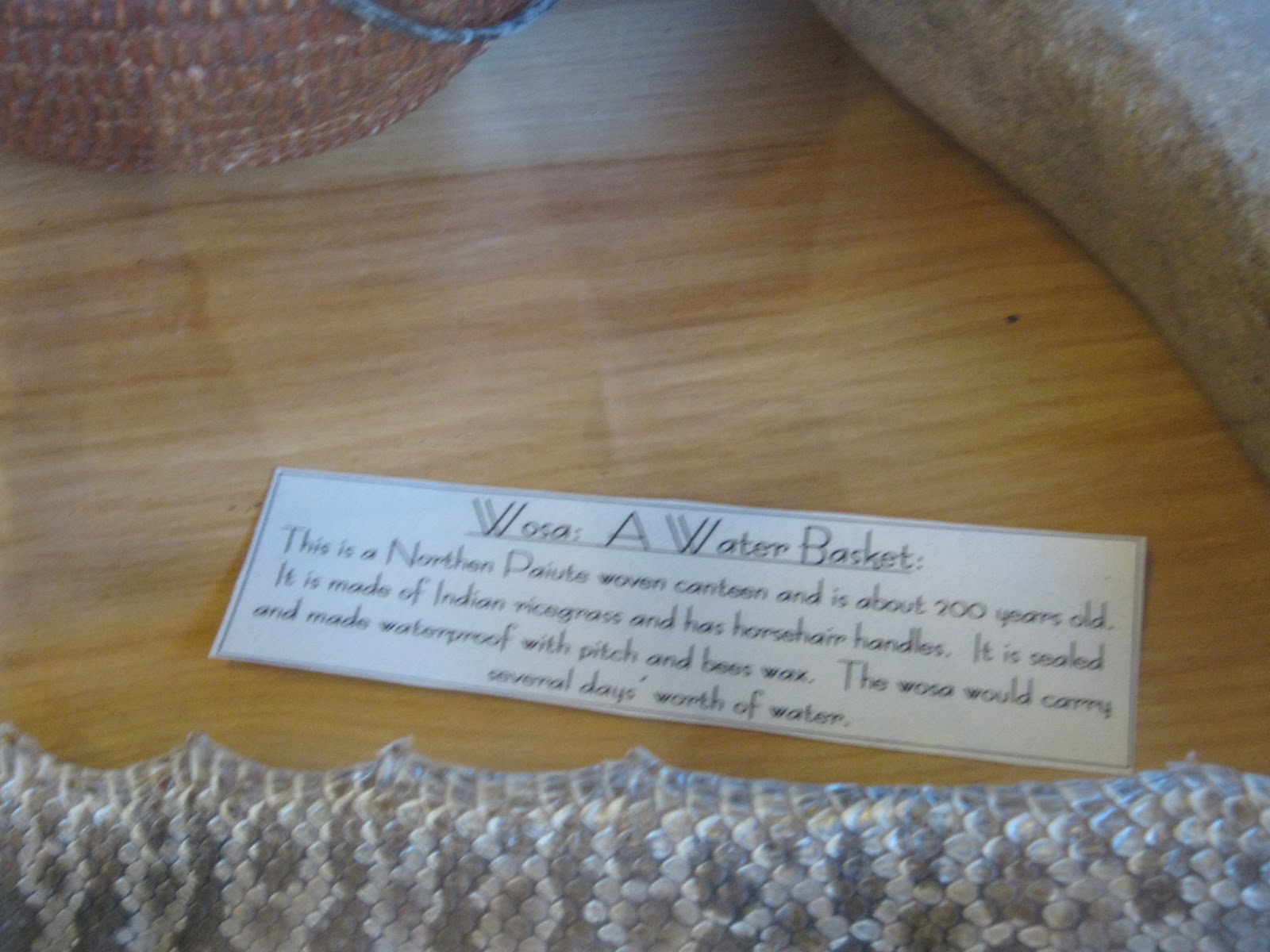
| This is a basketry water bottle or wosa. It is tightly woven and was lined with pitch and bee's wax. It is 200 or so years old. Bee's wax wasn't available until the white man arrived. |
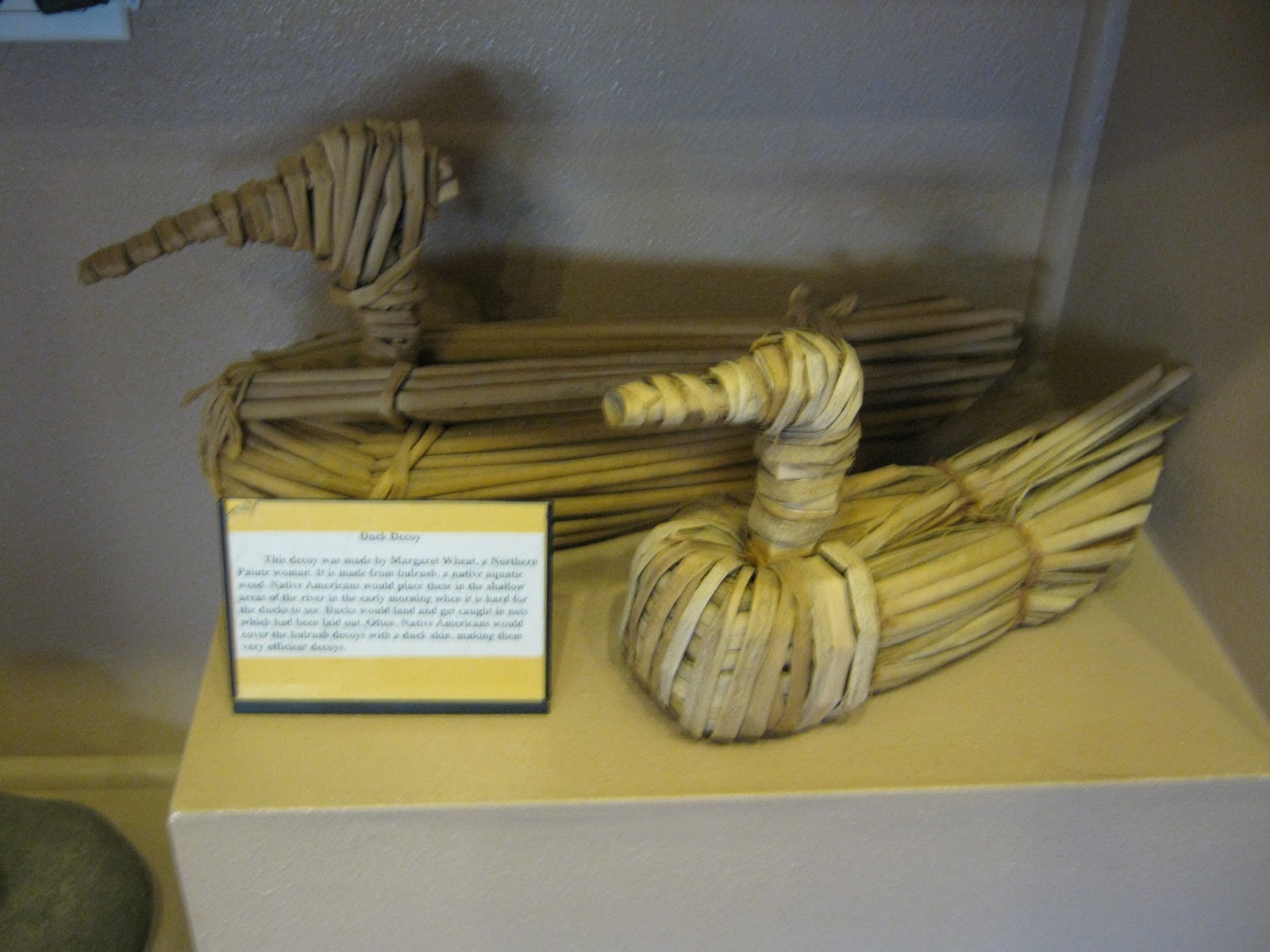
These replica duck decoys are typical of the Paiute and Shoshoni Indians. One was made by Margaret Wheat, a Paiute woman who authored "Survival Arts of the Primitive Paiutes" available on Amazon. Its the best book I know of on these folks and is very well illustrated and detailed.
Survival-Primitive-Paiute
I believe they are made from cattail and bull rush. The ones I saw in California's central valley were made of tule and looked exactly the same. I wonder if there was interaction between the California Indians and the Paiutes or Shoshoni? I wouldn't doubt it since there was extensive trade over the Sierra Nevada range.
These two photos are of effigy's the Indians made. They were used as talismans to help the hunt be successful. They were made from anything at hand and perhaps they were even used as toys by the children?
 |
| The folks who do these replications do a fantastic job! |
 |
| This poster tells about the atlatl. There is a gentleman there on weekends who gives atlatl demonstrations and you can even fire one off if you like. | | |
These next photos are of some of the many petroglyphs or rock drawings found throughout the area. There are thousands throughout the Snake river canyons and gorges. The Indians used a piece of quartzite and a hammerstone to peck and crumble these designs into the basalt boulders. The brown color on the rocks is caused by oxidation and microscopic life forms such as bacteria and lichen. Its also called "desert patina". The pecked designs show the rock under the patina which makes the designs stand out. Some of the very old drawings are quite dark due to the patina and time catching up with them. There are several recent (150 years or so) drawings done by white pioneers and travelers. The Oregon trail was a ways north of here near Fort Boise and undoubtedly there were some visitors from the wagon trains passing through.
 |
| The Oregon Trail |
 |
| Poster describing the petroglyphs and rocks. |
 |
| Unfortunately the meaning is lost as to whatt most of these represent so use your imagination. Some think this is a sun or a star but if you turn it upside down it looks like a stick figure of a human, kind of. |
 |
| This has a circle and three circles in a chain and a zig-zag line. I think the three in a row represent a rattlesnakes rattle. The rattlers are common here. |
 |
| Now this one does look like a sun. |
 |
| This one was done after the white man arrived. It is a domestic sheep. The Indian who drew it was probably quite amazed to see such an animal. They had never seen anything like it. The natural hole to the right is chipped around the edges. It is a "vision" rock. The Paiute and Shoshoni didn't use drugs in their vision quests. They fasted for days instead. They believed the visions would suck them back into the spirit world with them so they had these holes to stick their fingers into to hang onto this world. |
|
 |
| Here are three lizards, which are very common here. The other item's are a total mystery. The one at the far left looks like a lizard stick figure. |
 |
| Heres another shot of "lizard rock". Note the the figure "8"and string of dot's. It also shows a better picture of the "loaf of bread". |
 |
| Still on the same rock are these drawings. The "Christmas tree" is an enigma. The snake is an "x-ray" drawing and is very rare. It is a drawing of a snake cut open exposing its innards. The head with the extended tongue is on the right below the crack. |
 |
| Same "lizard" rock. More enigmatic designs. |
 |
| This is easily seen as a bird. |
 |
| Here's a tiny part of the boulder field where a lot of petroglyphs are found. The Indians encamped at the base of the cliffs. I imagine it was protection from the cold since the rocks held the suns heat for a long time. Also, they were far from the river and its myriad flying insects. |
 |
| Some say a devil and I think it looks like a Viking. Most call it "bat man". |
 |
| "Bat man" close up. |
 |
| A turtle and two ??? |
 |
| More drawings on this very busy rock.The one middle row, right and next to the last looks like a cows head. |
 |
| Heres the cows head and an udder underneath? Fanciful thinking on my part. |
 |
| This looks like a a man and a buffalo head. Its a vision rock so the guide said. |
 |
| Closer look at the buff head and I have no clue what that is to the left of the man. And the bird with the crack running through its right wing is very plain to see. |
 |
| Farther back and at an angle. Fortunately the sun was straight overhead and I was able to get these great shots. |
 |
| This must have been a favorite "bulletin board". All kinds of odd designs! Rows of circles with dots in them, etc.etc. The one at the very top looks |
 |
| This lizard was nice enough to pose for me. I wonder if he realizes his great, great grandpappy was drawn on a nearby rock? |
 |
| Mr. Lizard up close. These were food! Lizard on a stick! YUM! |
I heard people say how neat it would be to live back in those times. I say "no way!!!" The average life span was 25 years and if you got so much as an impacted tooth or an infected scratch, chances were good that it would kill you. The hunt for food was constant for the daily supply as well as long term. There wasn't much available in the winter so you had to stock up. And if certain things weren't abundant as usual, you may well starve. Riparian habitat was probably the most diverse for edible plants and wild life. That's why the Indians who lived and traveled through these vast canyons stayed near the water. If you venture just a few miles away it is dry, desolate high desert with water being very rare. These folks depended heavily on fish, wild fowl and wild plants for their diet and anything else was a bonus. I recall seeing a fish skeleton petroglyph on one of the rocks
 |
| This is a nice replica of a fish trap. They must have made and used hundreds of these a year. The river has trout, whitefish and bass. Catfish are abundant. |
Here are some shots of the surrounding canyon. It is very rough terrain and all of the rock is volcanic basalt. There are places where you can find some obsidian and chalcedony. These were the stones used for tool making. Basalt was used for mortars and pestles. These were left behind until the next year as they were too heavy to carry the long distances these people traveled.
 |
| This rugged cliff is directly across the river from the visitors center and there is a golden eagle nest that has been used for many, many generations, in fact it is the record holder for having been used so long. There is a spotting scope in the visitors center aimed directly at the nest. There is one adolescent eaglet occupying it at present. This area is part of the "Morley Nelson Snake River Birds of Prey National Conservation Area" sanctuary which has the largest concentration of nesting hawks, owls and eagles in America. 24 different species are noted. It covers 600,000 acres. |
 |
| More rugged terrain to the west. |
 |
| Looking southeast down the Snake river canyon. |
 |
| "Eagle nest" cliffs. |
This photo shows a reproduction of a typical wikkiup that served as the house for the Paiute and Shoshoni Indians. Its basically a stick and brush structure and I imagine it stayed fairly warm inside. The only blankets these folks possessed were made of many rabbit skins. They also made crude blankets from bull rush and cattail leaves. Both plants had great insulating value. They were also woven into mats to cover the dirt floor adding more insulation from the cold ground. I would imagine they slept outside during the heat of the summer.
Here are some of the local edible as well as useful plants. The currants were very tasty, especially the golden currants. In some of the dry caves of Nevada, archaeologists found raisins made from currants by these people. Google "Hidden cave" for some very interesting reading.
 |
| Bull rush. |
 |
| Bull rush again. |
 |
| Wild asparagus. A none native species. One of the plants Euell used to stalk. |
 |
| That's the wild asparagus in the right foreground and behind is milkweed. Milkweed is a very versatile plant. It makes cordage, insulation (the ripe seeds with their "parachutes") has edible properties: the young seed pod and also the newly sprouting plant. As it gets older it starts to produce a white milky sap, thus the name milkweed. The sap was used as a glue of sorts but I think it was too bitter to consume and older plants weren't eaten. |
 |
| Purple currant. |
 |
| Purple currant up close. The red ones aren't ripe yet and are very tart. |
 |
| Golden currants. |
 |
| The tasty golden currant up close. |
 |
| Our intrepid explorer gathering the fruits of the field. |
 |
| Yummy! |
 |
| Pretty, aren't they? |
 |
| This shows the three lobed leaf, an identification aid, a bit better. If its three big leaves and has white berries, you are eating poison ivy! Don't do that. |
 |
| Great or common mullien, Verbascum thapsus. The stalks were used for fire drills and the leaves as medicine for colds and as poultices. It wasn't a native and was introduced by the white man. The Indians were quick to take advantage of its many properties. |
Here are a few shots of a male western kingbird, Tyrannus verticalis. He was guarding his nest on Guffy bridge.
 |
| Remember to click on the photos for a bigger view. |
And speaking of Guffy bridge. It was built to run trains to the silver mining camps in Silver City and other towns in Owyhee county across the river. It never made it to any of them except Murphy. The plan was to build an electric railroad at the end of this line but it never happened. The railroad did bring the present agriculture to this area and that is a mainstay of the local economy. The town of Melba is a famous seed growing center.
 |
| A plaque about the bridge. | |
 |
| The bridge is in the background. They are building a new museum which should open around October. Its the farthest building in the distance just at the end of the right span of the bridge. |
 |
| Here's a nice poster of the area. |
 |
| This is a very well made replica of a coiled clay pot. Pottery like this was not used by any of these Indians. |
 |
| This explains the pot pictured above. |
I hope you enjoyed our little tour of Celebration park. For directions just do a search for it on Yahoo Maps: Celebration park, Melba, Idaho. It will take you right to it. Its very highly recommended by yours truly. Enjoy!