Rons Primitive Skills

Custom Search

Search This Blog

Showing posts with label health. Show all posts

Thursday, July 4, 2013

Update on the fire and the heat wave

Here's a link showing video of the fire in the Owyhee mountains of Malheur county, Oregon . The view on the video is the same as I had from my living room window here in the Spirit Ranch area. I heard on the news tonight that 70 square miles have been burnt. Amazing. The heat and dry weather combined with high winds did a nasty job but nature always restores and next spring the burnt area will probably be full of wildflowers. Most of the area is rabbit bush and some cedar and sagebrush. Hopefully there will be a lot of survivors. The fire tankers were flying in and out all day from Gowen Field in Boise http://www.museumerica.com/national-aerial-firefighting-museum-concept.html. I didn't see a sign of any smoke today so I think things are well under control.

The wind from the storm that caused this fire was gusting at least 40-50 MPH. The next night the wind from a similar storm reached gusts of 60-70 MPH here at the ranch! It did a lot of damage to the roofs in the neighborhood and knocked down a few tree's here on the property. I had a huge, half dead elm take a fall and it messed up some of the old farm vehicles here but not too badly. I spent most of the morning chasing junk out in the adjoining fields and picking up plenty of dead wood (read:firewood!)

The heat wave ended yesterday with a high of 102 degrees and today it got up to 98 degrees and is slowly going back to normal. It was rough working on the ranch and in the garden but life is good and God is good. I found myself enjoying working in the "cool" 90 degree weather today. Odd how fast we adapt to natural conditions. But, I still drank plenty of water and Gator Aid!
Take care everyone until next time..........

Tuesday, July 2, 2013

Crazy weather, heat, wind and a forest fire

Wow! Its 109 degrees here in the Treasure Valley! We are having quite a heat wave here in the northwest. Working in the garden past 10AM is torture. Fortunately everything is in the ground and its just maintenance such as watering and weeding. Last night I watched a thunder storm roll in from the west over the Owyhee (pronounced OH-WHY-HE) mountains and the lightening show was terrific! I saw where a particularly bright bolt struck and a minute or so later I noticed an orange light. I thought someone was 4 wheeling up in the hills so I got out my Minolta 8x to 20x zoom binoculars and set them on the tripod. Sure enough the lightening had set a wild fire. In a matter of a few hours it had spread over several thousand acres. The wind was terrific and helped it along. Today the Snake river valley is full of smoke and I can't see across the valley to the Owyhee's.
This weather reminds me of several things: be hydrated constantly! After a few hours work outside I started to feel the effects of heat sickness so I got in the shade and downed a bottle of Gator Aid. I still drink plenty of water but when you sweat a lot you loose valuable minerals and need to replace those electrolytes. Sometimes I put 1/4 teaspoon of sea salt in a quart of nice cold water. It helps replace some electrolytes but its not as efficient as Gator Aid. My trusty bandana is always soaking wet and worn around my neck cowboy fashion. This of course gets my tee shirt soaked which helps with the cooling. And I always wear a booney style hat, doctors orders because of the skin cancer and its a great shade giver as well. When its this hot and you work outside you just have to make sure you are drinking plenty of water.
The wind was gusting at around 60-70 MPH last night and when I awoke at 5AM I noticed a lot of damage here on the farm. An old dead elm finally bit the bullet and laid down. Fortunately it didn't take anything with it. There is a huge cottonwood that has a lot of dead limbs and I'm afraid its going to come down soon. If so it will only block the road until we get it cut up and moved but God help the person who has the misfortune of being under it if it falls. Several pieces of equipment were blown over and some roof damage to a shed or two but nothing really serious from the wind storm. I think the heat really gets the wind speed up as it cools in the evening. I don't know all the mechanics of weather but I think I read about this particular phenomenon somewhere.
Take care everyone and stay safe! Drink plenty of water and stay hydrated if you are out in the hot summer weather.

Monday, June 17, 2013

SAS Urban Survival Handbook by John "Lofty" Wiseman


I just received a copy of this book to review. Its name is "SAS Urban Survival Handbook" By John "Lofty" Wiseman who also wrote the immensely popular SAS Survival Handbook. My edition is the 2013 copy. It states on the cover "how to protect yourself against terrorism, natural disasters, fires, home invasions, and everyday health and safety hazards". So, its not just a "doomsday" type of book but one geared towards everyday, real world possibilities. It is written by a European, namely Great Britain, and it has some things that pertain to Europe but not the USA (in most cases-but, if you live in some anti-gun states you are SOL). The book is a paperback, 627 pages, and measures  8 1/4" by 5 1/4". Just right for tossing into the glove compartment or BOB. Amazon has it (there's even a Kindle edition): SAS Urban Survival Handbook

Here's a breakdown of the contents:
1. Essentials - Be a Survivor, Body Matters, Stress & City Survival kit.

Lots of good stuff here. The city survival kit is very simple to put together and is a must have in my opinion if you live in the city., especially a sizable one.

2. Safety First - Safe as Houses?, Electricity, Gas, Liquid Fuel, Solid Fuel, Water, Common Accidents, Room Check, Leaving the House, & Pets

This covers all the basic precautions associated with the above topics. Some is geared towards European houses but its easy enough to substitute American design such as electricity and plugs. When I lived in Berlin, Germany everything was 220 volt and the tongues on the plugs were round instead of spade shaped like their American counterparts. Also, if you wanted to run American made appliances you had to buy and use a step down transformer (220 volt to 120 volt)with the spade shaped socket holes. Most of us just bought German and didn't bother with the transformers. Lots of good stuff in this chapter and its geared for everyday life, not just SHTF situations.

3. DIY/Craft Hazards - Using Tools, Basic Tools, Power Tools, Hire Tools (rentals), Paint, Crafts, Ladders, Protective Clothing

This is something I haven't seen presented in any survival book. It covers the importance of safety around hand and power tools. Each year so many folks go to the emergency room because they didn't take the normal precautions with tools. There is a lot of info on how to properly use tools as well. Good material here, "Lofty"!

4. Poisons - Chemical Hazards, Alcohol, Types of Hazard, Safe Storage, Acute Poisoning, Chronic Poisoning, Kitchen/Living Areas, Bathroom, The Medicine Cupboard, Prescribed Medicines, Garage/Shed, Pesticides

Here's a lot of very good information on a topic that most folks simply fail to realize the risks of using and having in their homes. There is a very nice colored section on poisonous plants and mushrooms. Most of the plants are not wild species but ones a person may have planted for ornamental purposes. Its amazing how dangerous some garden plants can be due to their seeds, leaves, etc. that aren't used for food.

5. Fire - Fire Facts, Equipment, Drills, Fire!, Escape!

This little chapter has a lot of really important info. As it states at the beginning, fire isn't the main killer. Smoke and poisonous fumes are what do you in. Great advice on planning for, fighting and living through a fire disaster at home or away.

6. Security - Safe & Secure, Home Security, Security at Work, Vehicles

This is a topic that is, sadly, so timely. With all these crazy people shooting up schools, workplaces, etc. and criminals given just about free reign due to asinine laws (read GUN CONTROL!) and insane litigation this is an important chapter. In Europe and elsewhere, you are not allowed firearms so must resort to other means. Fortunately, for now and for most of us, we have the freedom to own guns. Buy and carry a good handgun. Just my opinion.

7. Work & Play - The Workplace, Leisure, Sport

This chapter deals with the risks involved in such activities. Its surprising how many things are a danger that I never thought of. Sports, of course, is one of the most injury prone activity there is. Good stuff!

8. In Transit - On the Move, Public Transport, Lifts (elevators)/Escalators, Travelling Abroad

There's a load of good common sense info in this chapter. Some surprising ideas are presented, especially the section on overseas travel.

9. Self-Defence (spelled defense in USA) - The Law, Being a Witness, Under Attack, High-Risk Groups, Self-Defence, Into Action, Animal Attack

A lot of this chapter pertains to Europe as far as the law is concerned. But, still, the information is food for thought and you should be familiar with the laws concerning self-defense where you live.
There is a good section on self-defense and another on dangerous animals such as poisonous snakes and other animals and insects. Vectors are included in this chapter. The section on signs is interesting. The meaning is pretty much the same as the signs in this country so I would imagine there is a worldwide standard.

10. Terrorism - Terrorist Threat, Bombs, Hijack/Kidnap, Under Fire, Risk Limitation, Bullet/Blastproofing

This is a timely topic. There is a lot of very good information in this chapter.

11. Disasters - Natural Disasters, Earthquake, Volcano, Hurricane, Tornado, Flood, Lightning, Drought, The Big Freeze

This is pretty much self explanatory. Important information for recognizing and dealing with these threats.

12. Health - Take Control, Childhood Diseases, Serious Diseases/Disorders, Genetic Disorders, Respiratory Problems, Eating Disorder, Food Hygiene,  Tropical Diseases, STD's, Parasites, Pets & Your Health, Bites/Stings, Substance Abuse, Emergencies, Save a Life!

This is a very good chapter on health and dealing with sickness or injury. On most diseases/disorders it has symptoms and action to take. It  gives a brief but thorough description of the maladies.

The book doesn't have an index but the way the chapters are arranged makes it easy to find whatever subject you are looking for. I am impressed with this book and I can tell a lot of work went into it. I give it a 10. Good job, John.

Monday, November 21, 2011

Castor oil plant-Bad beans

I was on my favorite trail today. I always see or discover something new when I hike it. Today I went along the river and found a big patch of Castor, Ricinus communis. This plant is now a well established invader. Originally from the Ethiopia region of tropical west Africa, this escapee has taken root and can be found in any well drained soil near water courses throughout the west. It came here as a decorative outdoors ornamental. The seeds are the source of castor oil which is used in a lot of different chemical manufacturing process's. For instance, Castrol motor oil contains castor oil. As well as a lot of different lubricants, medicines, etc. Castor "beans" are not beans at all but just big seeds. They also contain the deadliest plant poison known to man:ricin. Ricin was in the news lately. A group of old guys were going to use it to get rid of some government agents. Crazy old coots. Its also been used for chemical warfare. Nasty stuff. An amount equal to a grain of salt will kill an adult. The seeds are beautiful but deadly. A small child eating just one will probably die. An adult will die if they eat two or more. The seeds have been ground up and mixed with bait to kill rodents. And, from what I've read, there aren't any insect pests that bother castor plants or seeds. If your interested in learning more about this amazing plant, go to:
http://waynesword.palomar.edu/plmar99.htm
and: http://en.wikipedia.org/wiki/Castor_oil_plant

I can see a danger in some unknowing person thinking the pretty seeds would probably be good to eat. It would be their last bowl of beans. Nothing surprises me any more. I once asked a friend in Tucson what he was going to do with a big bag of coral beans and he said he thought he read some where that they were good to eat. Bad idea. They are another very toxic seed. His mother had gathered them years before to make rosary necklaces, a popular use for them. My advice is to research any and every plant you find. Never take a risk. When one or two seeds can kill you, its worth the time and effort. After all, you may find out some incredible things about the amazing plants around us.

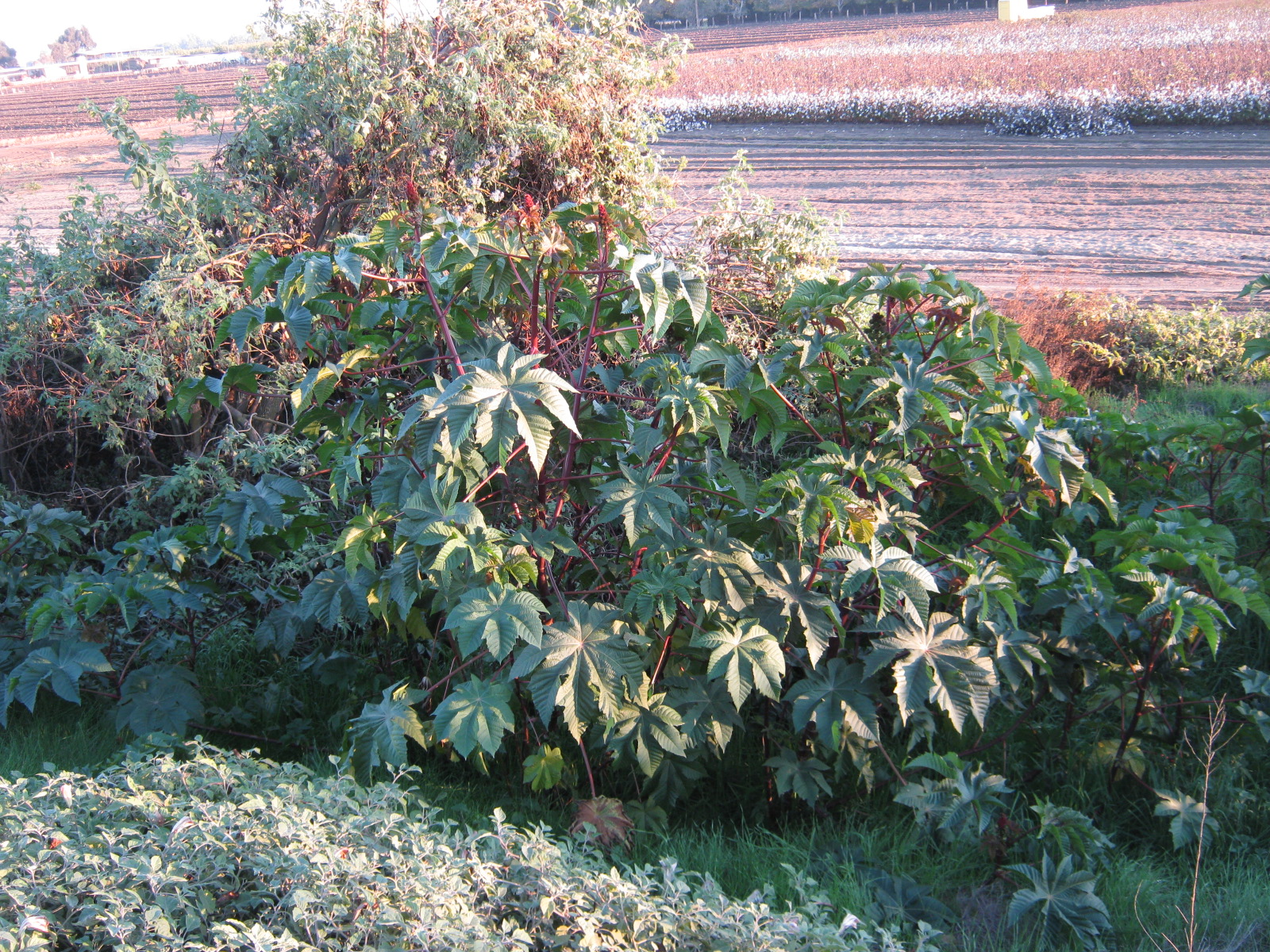
A nice big, showy ornamental. At the top of the plant are the red flower panicle's.

That's a seed cluster under the leaves in the middle.


Seed pods just ripening.

Notice the pods are divided into threes. Three seeds to each pod.

A shot of a complete cluster.

Pretty, aren't they? Like the human finger print, no two seeds have the same pattern. Each is unique.