I did this article in 2006. Its been posted at Survival Blog, Paleo Planet and Primitive Ways websites. I post it here for anyone who hasn't seen it.
CORDAGE IN NORTH AMERICA
By Ron Layton
This article is about cordage, one of the most used and necessary items for day to day life. Other than sinew, catgut, and rawhide, early man made his rope and string from more readily available plant material. Certain plant fibers were able to stand up to water immersion and made excellent nets and fishing line. Animal fibers, such as sinew and catgut, would stretch or unravel when wet and were more difficult to procure. Plant fibers were so much more abundant and easier to process; this left sinew and catgut for sewing, bow backing, arrow making and other arts requiring a strong, longer lasting material.
Another difference between plant and animal fibers is the strength comparison of a string made of sinew and a string of plant fiber. The plant fiber string, in most cases, would have to be twice the diameter of the sinew string to be of the same strength. Thus, for certain applications where weight and mass are important (such as arrow making) the thinner sinew would be the best choice. Sinew, catgut, and rawhide were not available in all areas since it usually comes from large animals. There aren't very many places in North America where a decent cordage fiber plant isn't available.
Cordage can be made from bark, branches, roots, stems, and leaves. In some rare cases the seed fluff from whorled milkweed and cottonwood was wound into cordage. This would be very labor intensive and was used mostly for ceremonial objects.
Trees can supply cordage by use of the bark, roots, and in a few cases, limbs. In the North, the roots of the spruce tree are used to make good, strong cordage. In the Great Lakes area, the Indians use this root for sewing the birch bark together on their canoes. The roots of the junipers, walnut, butternut, wild cherry, and osage orange are used too. Roots that grow in fine or sandy soil are the most favored as they are usually straighter and have fewer deformities. They are split in two or more sections and sometimes the outer bark is rubbed off. This is accomplished by rubbing the root section back and forth over a limb with somewhat rough bark, as if you were sawing it. Some bark and root binding materials tend to get a little brittle as they dry, so they are often soaked in water for a while before use. From my experience, roots make the best bow drill string of all. Always try to take only a few roots from several different trees. This doesn't kill the tree and insures a future supply of roots.
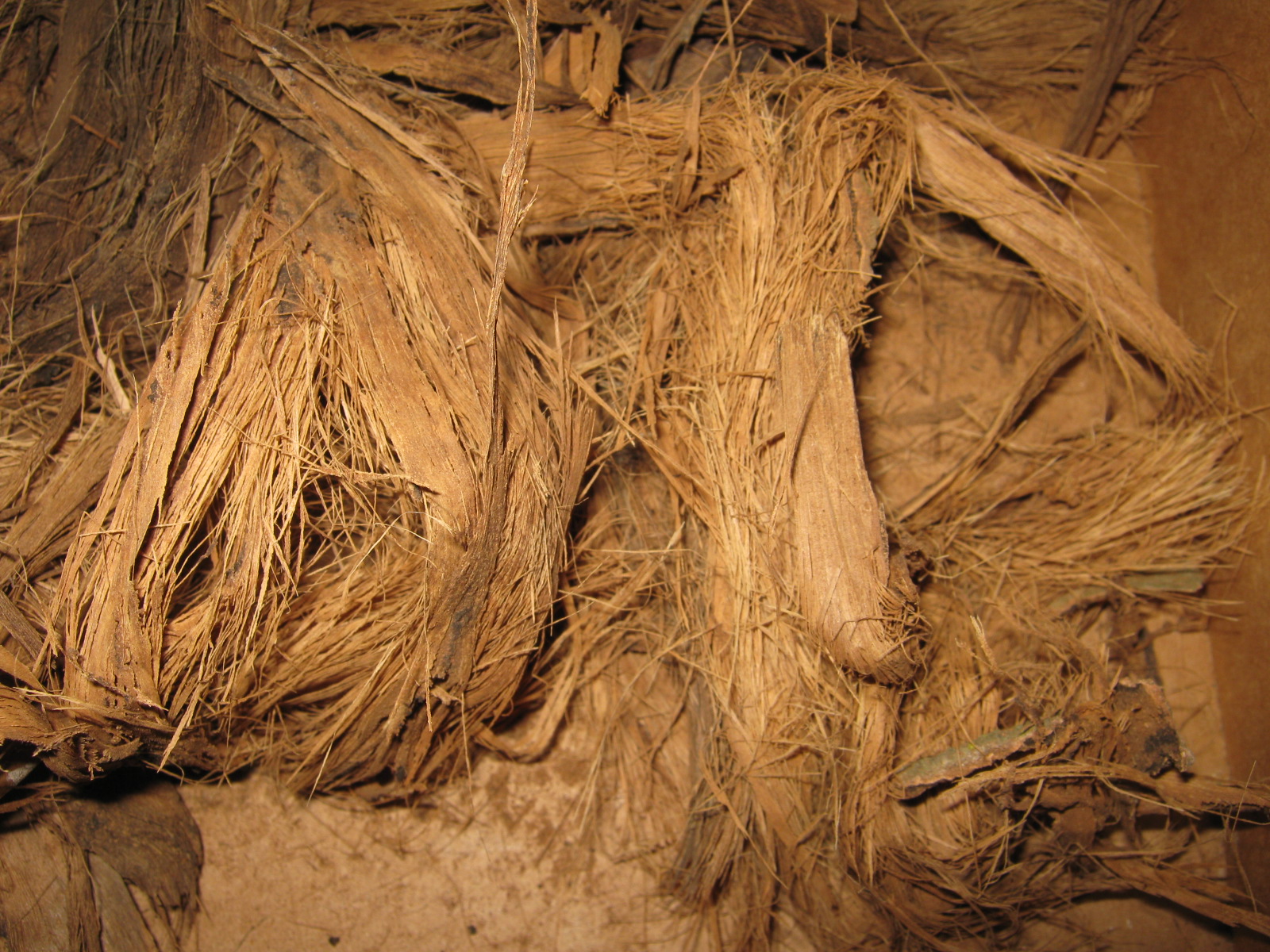
The best bark cordage comes from small limbs. The bark is thinner, and this process wont harm the tree. The inner bark of juniper, elm, cottonwood, aspen, basswood, moosewood, maple, willow, and desert willow are the most often used. Basswood is one of the better sources of fine bark cordage. The limbs-and in the case of a freshly fallen tree, the trunk-are stripped of their bark. This bark is held submerged for a few weeks until the inner bark starts to come loose in layers. These strips are then dried and stored for future use. When some cordage is needed, they're soaked for a while before braiding or twisting. Slippery elm and willow bark make good, strong cordage. Most barks are best gathered May thru August because the bark comes off a lot easier. Out of season, the bark can still be loosened and removed by pounding the limbs gently with a wood maul or mallet made from a branch about 3 in diameter. Another piece of thick branch should be used as an anvil. Both anvil and mallet should be made smooth as possible to deter ruining the bark. If you decide to use a rock for an anvil, the bark may be damaged beyond use. Pounding works well on such barks as pawpaw, hickory, elm, maple, willow, and poplar. Ive used slippery elm with the outer bark removed, and it made very strong rope for a wickiup shelter I was building. Many shrubs such as sagebrush, cliffrose, and flannelbush have usable bark as well. As an aside, most of these barks are used in basketry too.
Most grass stems and leaves used for cordage, such as sweetgrass, dunegrass, and the reeds are used whole without much further processing. Cattail leaves when used whole are usually braided into a somewhat usable rope. When shredded lengthwise, they make stronger cordage after they've been twisted together. The leaves of agave, yucca, and iris must be processed in some way to get the fibers. Agave has a sharp point at the end of the leaf that is hard and dense. This needle can be carefully pulled downward towards the base of the leaf and several fibers will remain attached. This can be used as is for sewing. To get the most fibers from an agave leaf, it is usually gently pounded or retted-that is, soaked in water until the fleshy part of the leaf rots away. One should use caution when working with agave, as the fresh leaf contains chemicals which cause dermatitis.
I prefer working with yucca; it is a very versatile plant to work with. In Paul Campbells book Survival Skills of Native California, there are several photos and references to articles made from yucca cordage. It was used by Indian tribes throughout the West to make nets, bow strings, and many other items. You can use the leaves green or dry. I prefer to process the green leaves by retting. After I gather a good sized bunch, I put them in a 5 gallon bucket, fill it with water, and let it set for a few days. When I check them, I hope to find most of the fleshy material is rotted or beginning to rot (you can tell the retting process is working by the terrible smell!). If the leaves are really mushy, they have retted long enough to work the fibers free. I do this by laying the leaves a few at a time on a board and running an old wood rolling pin over them to squeeze out the plant material; then the leaf remains are swooshed around in a bucket of clean water and the fibers are fairly cleaned of plant material. I then wring the bundles of fiber out and give them another rinse. This loosens even more plant material and the shorter, unusable fibers. These hanks of fiber are hung up to dry and put away till I need to make some cordage. This is the easiest way I have found to process yucca. In the wilds you could do the same by putting them in a stream or pool and weighing them down.
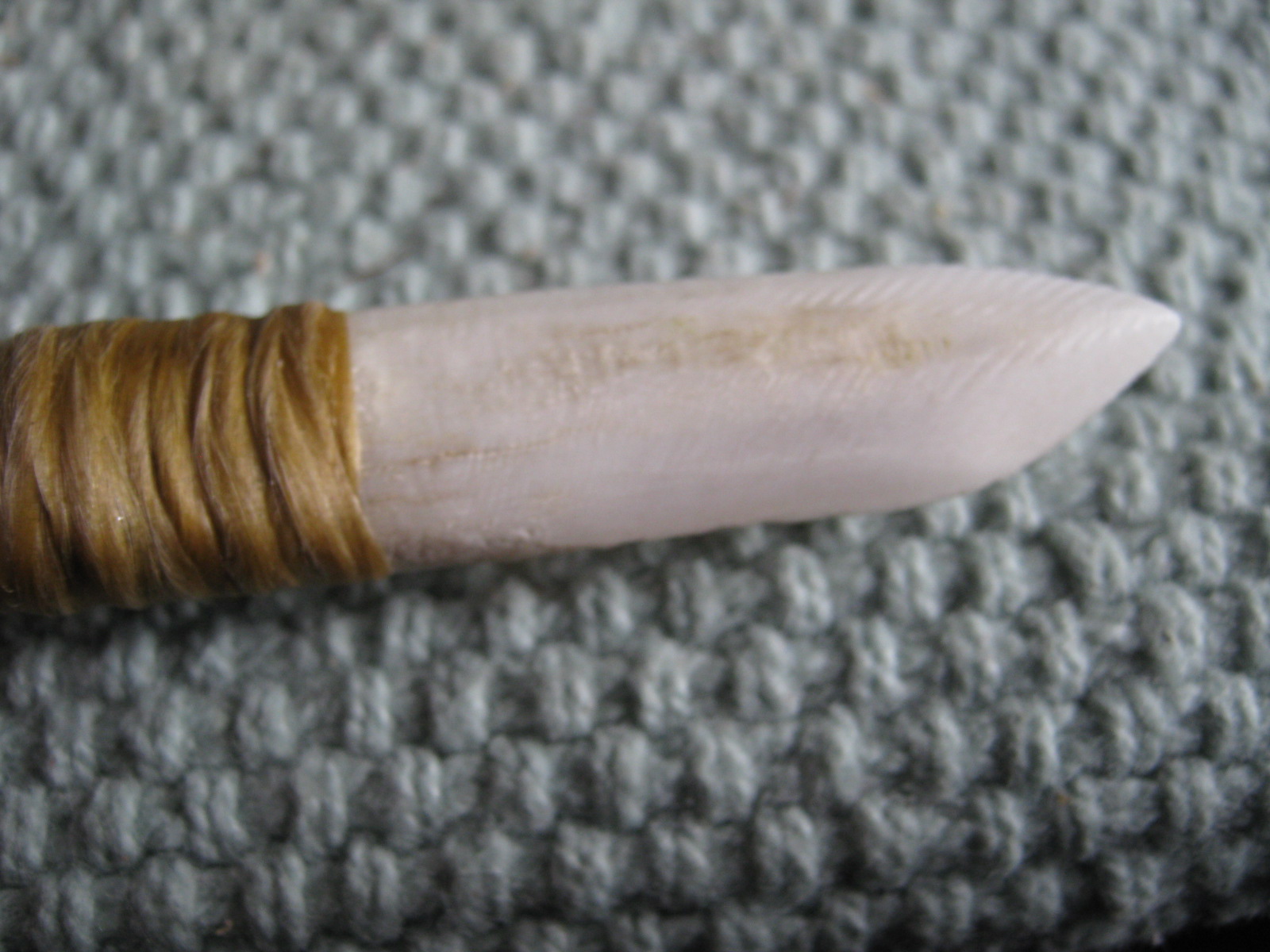
If you use the dry yucca leaves, you will have to pound them with the mallet and anvil technique. The pounded bundles are then rubbed between the hands to loosen any plant material. Ive heard of some folks who use a dull knife or stone flake to scrape the leaves and expose the fibers. I have tried this, but with limited success. I once cooked some yucca leaves to see if this would make them easier to work, but found the resulting fibers were a bit too stiff and hash, unlike the smooth, soft fibers from the retting process. Iris leaves have only two usable fiber strands per leaf. The average iris leaf is only one or two feet long. These fibers were highly valued considering the amount of labor it took to get a usable amount. The leaves are split lengthwise with the thumbnail. Sometimes an artificial thumbnail is used. Its made from a mussel shell attached to the thumb with a bit of cordage. The two leaf halves are then scraped on both sides with the mussel shell thumbnail. This exposes a silky white fiber. The iris was mostly used in the Pacific Northwest and the fibers were twisted into cordage for fishing line, netting, snares and many other items.
The stem sections of many different plants hold useful cordage fibers. Plants such as nettle, dogbane, velvet leaf, milkweed, prairie flax, thistle, and fireweed are valued for their quality fibers. I have processed many hundreds of feet of stinging nettle, dogbane, and milkweed cordage. These stems are hollow or have a pith core. They are collected in the fall after the last leaves have fallen off, usually after the first frost. The stems are left to dry in a warm place and then they are checked for brittleness. I then split them lengthwise, usually into four sections. These sections are easier to work with. Each section is carefully snapped every few inches, beginning at the bottom. As I snap each small section, I carefully peel the fiber bearing bark loose. Hopefully, Ill end up with a section of bark the full length of the stem. Short sections of bark are still useful as the fibers can be spliced onto longer sections of cordage. As I twist the sections into cordage, the dry brittle bark falls off leaving nice silky fiber. Sometimes the cord has to be twisted back and forth several times to loosen stubborn bark fragments. Some folks use a knife to scrape the bark off the stem before sectioning it but I prefer to just let it fall off while twisting. If you re not careful, you can scrape too deep and ruin the fiber.
Vines and branches are used as cordage. Grapevine, greenbrier, and hazelnut are just a few of the many different plants used in this fashion. Most vines are used for light weight tasks as they aren't very strong. Hazelnut withes are used to tie bundles of fire wood, and a strong cord with tumpline is tied to the bundle for transportation. These withes can be bent double and are also used as handles on stone axes and hammers.
Knowing the plants and techniques for making rope and cordage is only a small part of the many skills needed to survive. It is important to have a working knowledge of such skills as fire making, tool making, trapping, shelter construction, and others; these complement each other in the art of primitive survival. Several of the books in the bibliography illustrate the technique of turning fiber into cordage. Also, there are several sites on the Internet that illustrate the process of twisting fiber into cordage. If you are interested, do a Google search for cordage and primitive skills.
If you have any questions or comments, feel free to contact me at micron327@yahoo.net
Bibliography:
Survival Skills of Native California - Paul Campbell
Primitive Wilderness Living & Survival Skills Vol. 1 & 2 - John & Geri McPherson
Bushcraft - Mors Kochanski
Any of the Peterson Field Guides on flowering plants, trees and shrubs; these guides are well illustrated and there are different guides for both the Eastern and Western United States.
CORDAGE FROM PLANTS (North American)
Abutilon abutilon=Velvet Leaf,Indian Mallow (stem)
Acer glabrum=Rocky Mountain Maple (bark)
Acer macrophyllum=Bigleaf maple (bark)
Acorus calamus=Sweetflag (leaves)
Agave americana=American Century Plant (leaves)
Agave deserti=Desert Agave (leaves)
Agave lechuguilla=Lechuguilla (leaves)
Agave parryi= Parry Agave (leaves)
Agave schottii= Schott Agave (leaves)
Agave toumeyana =Toumey Agave (leaves)
Agave utahensis=Century Plant (leaves)
Althaea officinalis=Marsh Mallow (stem)
Amelanchier alnifolia=Saskatoon Serviceberry (branch's)
Apocynum androsaemifolium=Dogbane (stem)
Apocynum cannabinum= Dogbane,Black Indian
Hemp,Armyroot (stem)
Arctium lapa= Burdock (stem)
Argentina anserina=Silverweed Cinquefoil (runners)
Artemisia tridentata=Sagebrush (bark)
Asclepias asperula=Antelope Horns Milkweed (stem)
Asclepias eriocarpa=Woolypod Milkweed (stem)
Asclepias fascicularis=Mexican Whorled Milkweed (stem)
Asclepias hallii=Purple Milkweed (stem)
Asclepias incarnata=Swamp Milkweed (stem)
Asclepias lanceolata=Narrow Leaved Purple Milkweed (stem)
Asclepias ovalifolia=Milkweed (stem)
Asclepias pulchra=Hairy Milkweed,White Indian Hemp (stem)
Asclepias pumila=Low Milkweed (stem)
Asclepias purpurascens=Purple Milkweed (stem)
Asclepias quadrifolia=Fourleaf Milkweed (stem)
Asclepias rubra=Red Milkweed (stem)
Asclepias speciosa=Showy Milkweed (stem)
Asclepias subverticillata=Whorled Milkweed (seed hair)
Asclepias syriaca=Common Milkweed (stem)
Asclepias tuberosa=Butterfly Weed,Pleurisy Root (stem)
Asclepias viridiflora=Green Milkweed (stem)
Asimina triloba=Pawpaw (bark & root)
Boehmeria cylindrica=False Nettle (stem)
Carex barbarae=Santa Barbara Sedge (root)
Carya =Hickory (bark & root)
Cedrus =Cedar (bark & root)
Cercis canadensis= California Redbud (bark)
Chamaecyparis nootkatensis=Alaska Cedar (bark)
Chamerion angustifolium=Fireweed (stem)
Chilopsis linearis=Desert Willow (bark)
Cirsium arvense=Canadian Thistle (stem)
Cirsium edule= Edible Thistle (stem)
Cirsium vulgare=Bull Thistle (stem)
Clematis ligusticifolia=Western White Clematis (stem)
Convolvulus arvensis=Field Bindweed (stem)
Cornus sericea=Redosier Dogwood (bark)
Corylus cornuta var. californica=California Hazelnut (twigs)
Corylus cornuta var. cornuta=Beaked Hazelnut (twigs)
Cowania mexicana=Cliffrose (bark)
Dirca palustris=Moosewood,Leatherwood (bark)
Elaeagnus commutata=Silverberry (bark)
Fraxinus =Ash (bark)
Fremontodendron californicum= California Flannelbush (bark)
Geranium atropurpureum=Western Purple Cranesbill (stem)
Glyceria Canadensis =Sweetgrass (stem)
Gossypium hirsutum=Upland Cotton (fuzz)
Hoita macrostachya=Large Leatherroot (root)
Iris douglasiana=Western Iris (leaves)
Iris innominata=Del Norte County Iris (leaves & root)
Iris macrosiphon=Bowltube Iris (leaves)
Iris tenax=Klamath Iris (leaves)
Juglans cinerea=Butternut (bark)
Juglans nigra =Black Walnut (bark & root)
Juncus effusus =Common Rush (stem)
Juncus tenuis =Poverty Rush (stem)
Juniperus californica =California Juniper (bark & root)
Juniperus communis =Common Juniper (bark & root)
Juniperus deppiana = Alligator Juniper (bark & root)
Juniperus horizontalis =Creeping Juniper (bark & root)
Juniperus monosperma= Oneseed Juniper (bark & root)
Juniperus occidentalis =Western Juniper (bark & root)
Juniperus osteosperma =Utah Juniper (bark & root)
Laportea canadensis=Canadian Woodnettle (stem)
Larix laricina=Tamarack (root)
Leymus mollis=American Dunegrass (leaves)
Linaria linaria=Toad Flax (stem)
Linum lewisii=Prairie Flax (root & stem)
Liriodendron tulipifera= Tulip Tree (bark)
Lonicera ciliosa=Orange Honeysuckle (stem)
Lupinus arboreus=Bush Lupine (root)
Maclura pomifera=Osage Orange (root)
Morus alba= White Mulberry (root)
Morus microphylla=Texas Mulberry (root)
Morus rubra= Red Mulberry (root)
Nereocystis luetkeana=Bull Whip Kelp (stem)
Nolina microcarpa=Sacahuista (Agavaceae) (leaves)
Oenothera biennis=Evening Primrose (stem)
Phragmites communis=Reed Grass (stem & leaves)
Picea engelmannii =Engelmanns Spruce (root & limb)
Picea glauca=White Spruce (root)
Picea mariana=Black Spruce (root)
Picea sitchensis=Sitka Spruce (root)
Populus balsamifera=Brayshaw Black Cottonwood (bark)
Populus deltoides=Eastern Cottonwood (bark)
Populus fremontii=Fremonts Cottonwood (bark)
Populus tremuloides= Quaking Aspen (bark)
Potamogeton diversifolius=Waterthread Pondweed (stem)
Prosopis glandulosa=Honey Mesquite (bark)
Prunus emarginata =Bitter Cherry (bark & root)
Psoralea macrostachya= (stem)
Psoralidium lanceolatum= Lemon Scurfpea (root)
Quercus =Oak (bark & root)
Ribes divaricatum=Spreading Gooseberry (root)
Ribes lacustre=Prickly Currant (root)
Ribes lobbii=Gummy Gooseberry (root)
Robinia pseudoacacia = Black Locust (root)
Salix bebbiana= Beb Willow (bark)
Salix discolor=Pussy Willow (bark)
Salix exigua= Sandbar Willow (bark)
Salix laevigata=Red Willow (bark)
Salix lasiolepis= Arroyo Willow (bark)
Salix lucida= Pacific Willow (bark)
Salix lutea=Yellow Willow (bark)
Salix melanopsis= Dusky Willow (bark)
Salix scouleriana= Scoulers Willow (bark)
Salix sitchensis= Sitka Willow (bark)
Salvia =Sage (root)
Scirpus acutus =Beetle Hardstem Bulrush (root & stem)
Sesbania macrocarpa=Wild Hemp (stem)
Serenoa repens=Saw Palmetto (leaves)
Smilax =Greenbrier (vine)
Taxodium distichum=Baldcypress (bark)
Thuja plicata=Western Redcedar (bark & limbs)
Tilia americana =Basswood
(bark)
Tillandsia usneoides=Spanish Moss (stem)
Tsuga canadensis=Eastern Hemlock(root)
Typha latifolia=Broad-leaved Cattail (leaves)
Typha angustifolia=Narrow-leaved Cattail (leaves)
Typha domingensis=Southern Cattail (leaves)
Ulmus rubra =Slippery Elm (bark & root)
Urtica dioica=Stinging Nettle (stem)
Urtica dioica ssp. holosericea=Stinging Nettle (stem)
Urtica dioica ssp. gracilis=California Nettle (stem)
Vicia americana=American Vetch (root)
Vitis aestivalis=Summer Grape (vine)
Vitis californica=California Wild Grape (vine)
Yucca angustissima=Narrowleaf Yucca (leaves)
Yucca baccata=Banana Yucca (leaves)
Yucca baileyi=Navajo Yucca (leaves)
Yucca brevifolia=Joshua Tree (leaves)
Yucca elata=Soaptree Yucca (leaves)
Yucca glauca=Small Soapweed (leaves)
Yucca harrimaniae =Spanish Bayonet (leaves)
Yucca shidigera=Mojave Yucca (leaves)
Yucca schottii =Schott Yucca (leaves)
Yucca Whipplei= Chaparral Yucca (leaves)
"Not a public domain piece. Originally posted at www.survivalBlog.com"





 by Moerman. Martha uses it for basketry and I hope to find references as to how often its used. Its an interesting plant and as soon as I finish playing with it I'll post the results.