Rons Primitive Skills

Custom Search

Search This Blog

Showing posts with label Florida. Show all posts

Thursday, February 4, 2021

Condor Village Parang, Using the Fire Tube, and Wild Edible Plants

 The Condor Village Parang is a hit! I've been working along the fenceline for last few days and it has done a sterling job. I will have to work on the handle to make it a hair smaller-a 4-in-hand file will do the trick and a finish up with sandpaper. My only complaint about the blade is it is convex grind and I will have to remedy that. It still cuts great but I love a flat grind. I've made knives so I have the confidence that I won't wreck this fine tool. I have no complaints about the sheath. It looks like Condor has fixed the problems they had years ago. I see online where some folks have a problem with it being a slow draw blade. Well, this is a tool and not anything near a self defense knife. If you're worried about that then you sure as hell better be packing. My choice is my .357 magnum with 4 inch barrel and target sights. In my opinion you can't beat a revolver.

I've had a few questions about the fire tube. Here's how it works. You get a nice red glowing tip on the cotton with a spark from your ferro rod/sparker/flint and steel. Blow on the glowing ember and put the whole deal into your already prepared birdsnest of tinder. Blow on the nest and when you see thick smoke you should be close to combustion. Keep blowing gently until you see fire. All done. Now pull the rope/wick back into the tube and leave an empty space at least 1/4 inch. Put your finger over the end of the tube and in seconds the ember dies. Let it cool of for a bit and wrap everything backup and put it away. I am careful not to damage the charred end too much so that I can get a good light the next time I put steel to it.

I notice everything going on here at the farm and be it birds, critters or plants I have an idea of whats happening. This week I found several edible wild plants that are coming up. Its been a not so typical north Florida winter so far. We've had more than the usual freezing nights and frost. We've also had a lot of rain. The days are getting longer and it can get up to 70 during the day. This is bringing a lot of stuff to the surface. Here's what I've spotted so far:

shepherds purse  Capsella bursa-pastoris

cleavers Galium sp.

chickweed Stellaria media

henbit Lamium amplexicaule

Florida betony Stachys Floridana


 These two photos show shepherds purse. It gets its name from the shape of the heart shaped seed pods. Note long narrow leaves and tiny white flowers. The whole plant is edible. The lower photo also shows henbit, cranesbill geranium and chickweed.


 These two photos show cleavers. It has a square stem and gets its name from the tiny hooks all along the stem which make the plant stick or cleave to your clothing. Entire plant is edible but its best when young and tender. Older plants can be boiled.


 These two photos shoe chickweed. The first photo has chickweed and henbit and the second two species of chickweed. The whole plant can be eaten.


These two photos show henbit. In the first it is associated with chickweed and cranesbill geranium. The henbit has the tall square stems. The second photo has a good example of how easy it is to confuse plants. The cranesbill geranium has deep grooves in the leaves and small stems whereas the henbit has rounded scalloped leaves and bigger square stems. Henbit is edible raw when young and the older plants need to be boiled and rinsed.


 These three photos show Florida betony. It has square stems and is in the mint family. The first two photos show the plant structure and the leaves while the third photo shows immature roots and tubers. Its also called rattlesnake radish for obvious reasons. In the mid to late summer these tubers get up to five inch's long and its easy to gather a latge quantity. The roots and tubers are eaten raw and have a unique taste, some say like celery. The only problem with this plant is the fact that it is one of the most fast spreading and invasive plants in Florida. It ranks right up there with wandering jew, mexican poinsetta, and Bidens alba or spanish needles. I've batted them all. They're winning.


Standard cautionary notice!!! Never eat a plant you find in the wild without 100% positive identification. The wrong plant can kill you. Period. There are a ton of books out there these days that will lead you in the right direction. Here are the ones I use:

Botany in a Day by Thomas Elpel-super good book to teach you plants identification!

Edible Wild Plants of Eastern North America by Fernald and Kinsey-excellent book with drawings and uses.

Peterson Field Guide to Edible Wild Plants Eastern/Central North America by Peterson-one of the best with excellent illustrations and photos as well as uses.

Wild Edible Plants of Western North America by Kirk. I depended on this book when I lived and traveled in the western US. It has great drawings and descriptions as well as habitat and uses. Most of the plants are also found nation wide.

Of course there are a number of great books that I haven't mentioned but you can check them out on Amazon and see if its something you think you can use. Just do a search for "edible wild plants, foraging, wildcrafting".

Wednesday, January 20, 2021

Hi-jacked and un-jacked

My blog has been hijacked and come to find out they never posted anything. They did delete a bunch of my stuff but that can be fixed. Weird. It took a lot of work to get the powers that be to believe me when I told them I am who I say I am and I'm the author/owner/creator of Rons Primitive Skills. So finally after a long break I'm back. I've been doing a lot of primitive goodness these past years and will have gobs of goodies to share. I don't do Facebook anymore and I don't hang out at any forums. I've been doing a lot of research and working 12 hour days. Our business takes up most of my time. I have some articles to post soon such as the fire plow, some new and exotic cordage plants,how to get anything useful from low grade coastal chert and some more fire making fun stuff. We're still here in Florida and have been casually looking at some sites in Missouri and Tennessee. I have a lot of work to do to make this place get a good market value. We will try to sell it as a working hobby farm/horticulture business. I've gotten rid of a lot of gear over the last 7 years and I've bought some new things, too.I whittled my library down big time when I was still in California and now I only keep a few very good books. Now that our business is up and running I should be able to carve out some time for frequent posts. Stay tuned.....

Wednesday, January 15, 2014

Chinese water chestnuts propagation

I received a package from a very decent person here in Florida. It contained 10 corms of the Chinese water chestnut, Eleocharis dulcis. It will grow quite well here in Florida and I am zone 8a/8b depending on the weather. I am rather enjoying all the exotic (to me, anyway) plants, both native and cultivated, here in sunny Florida. My fiance, Annie, is an ardent Florida gardener and has taught me a lot about southern gardening which is completely different from anything I have ever experienced up north or out west. Here there is no "end" to the growing season as far as gardens go. The only problem we have had was a few nights of frost so far. We have radishes, carrots, and beets in the ground and a very healthy stock of tomatoes and peppers in trays getting ready for transplanting. We use only heirloom and non GMO, non hybrid organic seeds. These first photos show how I planted the water chestnuts in a temporary container that I bring in every night. I will transplant them to a kiddie wading pool after the last frost passes. If you are interested in these delicious plants do a search for Chinese water chestnuts and you'll see they are not hard at all to propagate. I would highly encourage anyone with an interest in exotic plants and southern gardening to go to http://www.floridasurvivalgardening.com/ This is a great site and has tons of interesting information. David is an expert on southern gardening.

The corms-some are sprouting already.

Another shot of the corms on our planting table.

The dirt-a mix of sandy loam and a bit of the local pipe clay.

Here's how much dirt I put in the bucket. Its a 2 1/2 gallon bucket.

Here are the corms before covering.

A closeup of the uncovered corms. I will leave the sprouts exposed above the surface of the dirt.

I use this specially modified bucket to water things that need the least disturbance to the soil. Its also very handy for draining wet potting soil.

Here's the bucket and contents before water is added.

We have several containers on the property to collect rain water. In the summer these can fast become mosquito heaven so we keep them covered.

Filling the watering bucket.

Adding the water to the soil with corms.


This shows the soil with about 6 inches of water over the soil.

The complete project-setting in the sun with our seedlings on the starter tray racks.

This and the next two photos are shots of our starter trays with very happy seedlings getting acclimated.

Peppers, cabbage and tomatoes.

The racks-recycled shelving units from a retailer long gone. The white ones are adjustable for shelf distance. This is a southern exposure and gets a good dose of sunshine all day.

Odd visitors

I caught a glimpse of these flying over a few weeks ago and had my Kodak handy. The American Buff geese were not very happy about it but I was quite thrilled. They are F22 Raptors. Pretty neat to watch several million dollars worth of airplane fly over. Awesome!!!


Tuesday, December 10, 2013

Green Carving Wood-Yaupon

Back in the middle of November I was clearing some of the brush and small trees from around the property. I took down the largest yaupon holly tree, Ilex vomitoria, I have yet seen. It was 20 feet tall and had a diameter at the base of 5 inches. I decided to cut it into 2 foot sections and seal the ends with latex paint for future carving material.  The reason for sealing it is the habit of all holly trees to check and crack like crazy if they dry too fast. Its such a dense and beautiful wood and I don't want to waste an inch.
Yaupon isn't scarce here. I can count 100 of his cousins in 10 minutes within 20 feet of the stump. I have a few other holly trees in line for harvesting and I believe they are American holly, Ilex opaca. None of them are as large as the yaupon tree I took down, most being at the most 3 inches in diameter. These, too, will get the same treatment as the yaupon. I let the yaupon log air out and dry a little in the shade for about a month before I cut it and sealed it. I then moved the wood to our aviary to keep it out of the weather and give it a cool, shady place to dry. This wood is used for turning, inlay and carving. I plan to make a lot of spoons and utensils with some of this wood. A search for green wood carving has show quite a few pages and a lot of info on the subject. Looks promising. Here's a link that mentions yaupon holly in a wood working forum. Its the last post at the bottom: http://lumberjocks.com/topics/8709

Here are some photo's.


2 foot sections fresh cut & ready to treat

3 1/4" should be plenty big enough to get some good carvings. This wood will yield a lot of spoons and kitchen utensils as well as other good things!
Nice clean wood with a lot of potential.
I weighed each one to see how much they will loose after a month or so. It will probably take a few years to completely season and dry. I intend to sell them green as well as seasoned.
Another nice log.


Even the small stuff has some potential.
Sealed and ready to be put up.

In the aviary drying and waiting for sales.


Monday, December 9, 2013

Critters continued

Here are some more photo's of the local fauna. Enjoy and please don't be afraid to ask questions. Thanks everyone!

eastern ringneck snake Diadophis punctatus
I found this handsome fellow under an old bucket yesterday. They are very docile and quite harmless to humans. They are the only species within their genus and have rear fangs and are poisonous. However the chance of being bitten is so darn remote due to the tiny size of the mouth. They bite their prey (worms, slugs, frogs, salamander and lizards as well as juvenile snakes of other species) and constrict. The venom eventually kills or incapacitates its meal. The venom is not produced in regular poison glands like a rattlesnake but in tiny organs called Duvernoy's gland which is located directly behind its eye. They rarely even attempt to bite a human and this would seem to prove that their poison is used for feeding rather than defensive purposes. They are fairly common, but being nocturnal, they are seldom seen. Special thanks to Annie for doing the photography and for sharing my love for all things natural.

American gree treefrog Hylidae cinerea

American gree treefrog Hylidae cinerea
 Another common resident here at the property. At night they like to climb the office window where Annie and I work and ambush the light loving insects. Cute little critters, aren't they? By the way, they are the state amphibian for Georgia and Louisiana.

Here's a full grown one-about 2 1/2 inches long perched on an elephant ear stem.
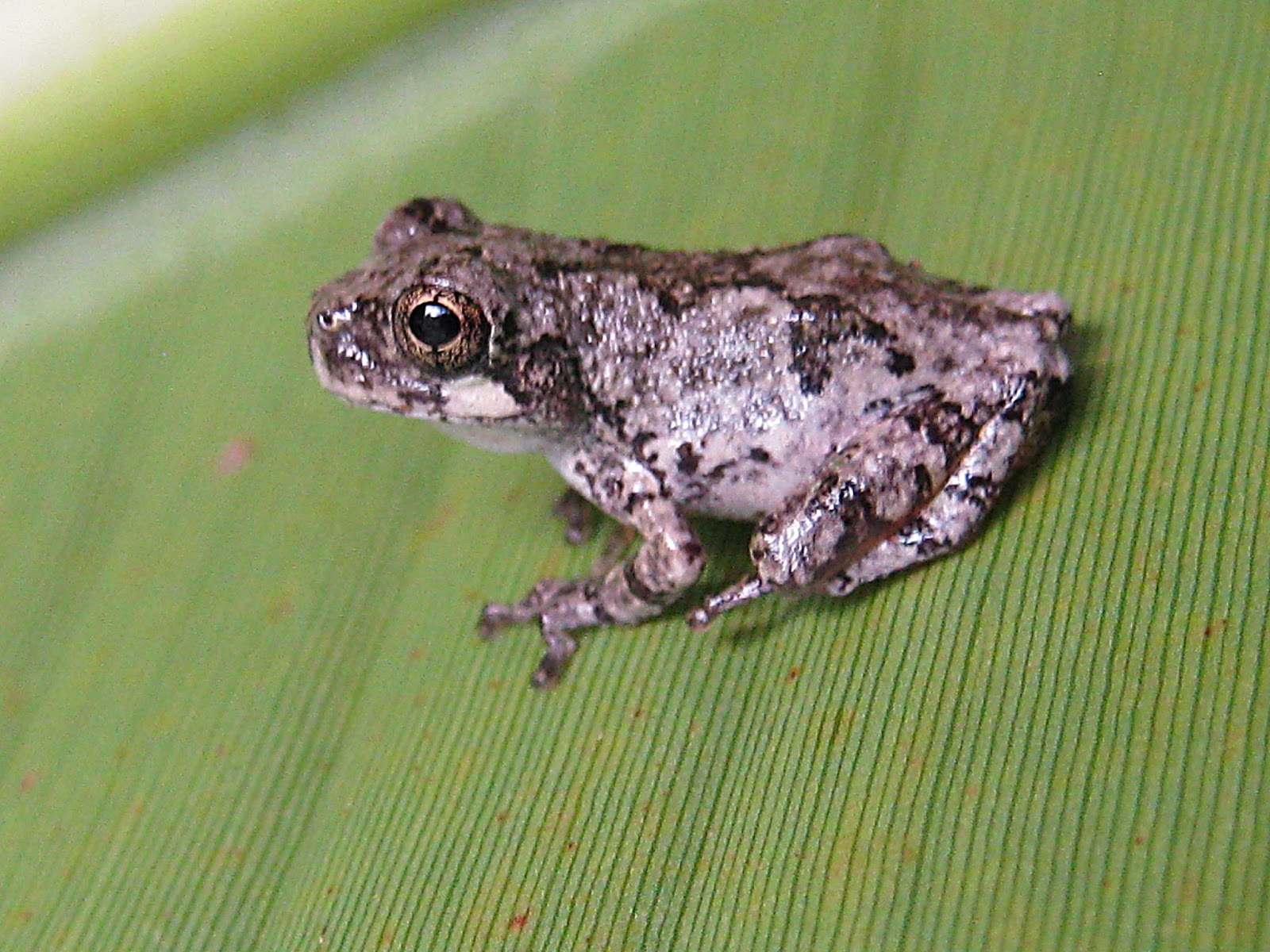
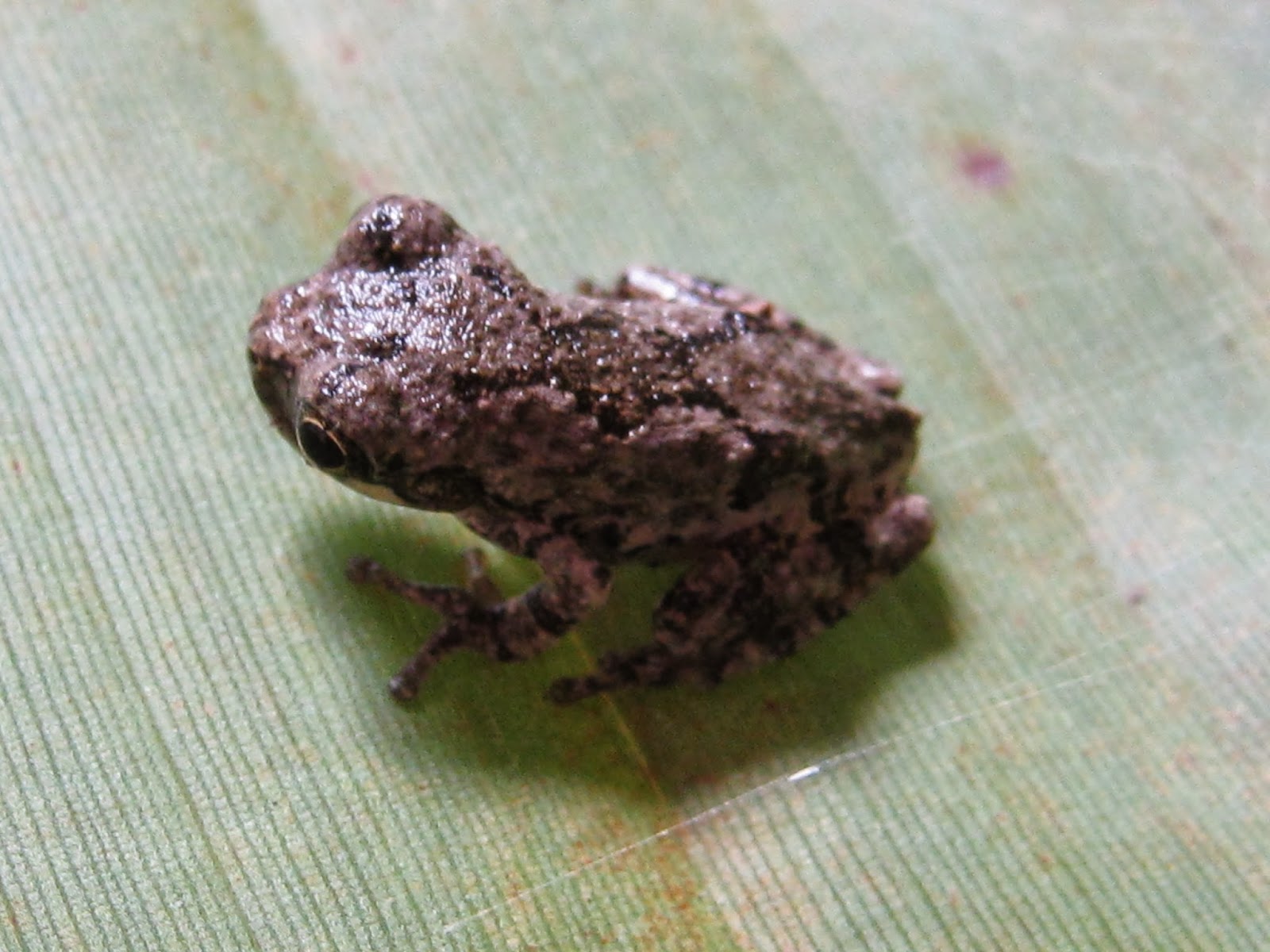
Copes Gray Treefrog Hyla chrysoscelis

Copes Gray Treefrog Hyla chrysoscelis
 Anyone see the skull and crossbones on his back? That design would be more appropriate to a poison arrow frog from Central America.

Copes Gray Treefrog Hyla chrysoscelis

This handsome little guy is usually found hiding during the day under debris and comes out at night to eat. No two Copes have the same pattern. Each is individual and as you can see in the last photo it is very good camouflage.

Again, due to unauthorized use, I must repeat, all subject matter and photo's are my personal work and are in my copyright. Please don't republish them without my permission. Thanks! More to come so stay tuned!